
[Editor's note: This article was originally written in 2020 but has been updated in 2026 for comprehensiveness and accuracy.]
Light is one of the most common migraine triggers, so it may surprise you that one narrow band of green light is being studied as a treatment. Here’s what the latest research, through 2026, says about whether green light therapy works, who it might help, and how to try it safely.
Light, migraine and a surprising exception
Migraine affects roughly 12% of U.S. adults, a rate that has held steady for about 30 years, while migraine-related disability has grown. Women are affected about three times as often as men. Worldwide, migraine is among the leading causes of years lived with disability.
Light sensitivity (photophobia) is one of the most common and disabling migraine symptoms. Harvard researchers have noted that more than 80% of migraine attacks are associated with, and worsened by, light sensitivity, which drives many people into dark rooms during an attack. Bright or flickering light can also trigger migraines in susceptible people.
So it may surprise you that one specific color of light, a narrow band of green, is being studied as a way to ease light sensitivity and possibly reduce how often migraines happen. The evidence has grown since this article was first published in 2020, but it is still early. Here is what the research shows as of late 2026.
What is green light therapy?
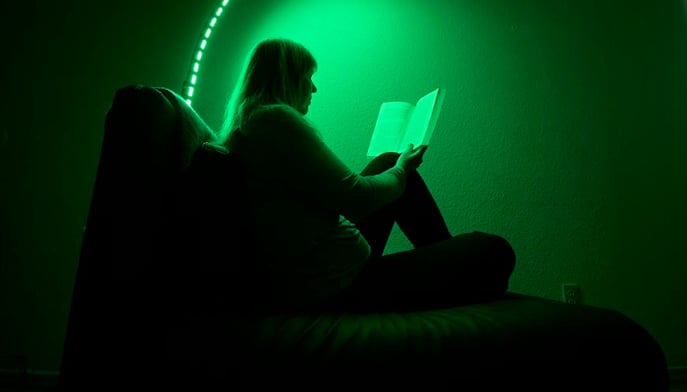
Green light therapy means sitting in dim, narrow-band green light, usually around 520–530 nanometers (nm), for a set time while other light sources are off. It is not the same as looking at a green-tinted bulb or a green screen filter. Most ordinary "green" bulbs emit a broad mix of wavelengths that may not have the same effect.
Researchers have tested it in three main ways:
- Daily preventive exposure. Sitting in a room lit only by a green LED strip or lamp for 1–2 hours a day over several weeks, to try to reduce how often migraines happen.
- Use during an attack. Turning on a green lamp during a migraine, instead of retreating to a completely dark room, to ease pain and light sensitivity.
- Filtering lenses and green-enriched lighting. Glasses that block most non-green light, or white room lighting with extra green added, to make everyday light less irritating.
Green light therapy is non-invasive and drug-free, which is why many patients are interested. But these approaches are not interchangeable, and the evidence differs for each.
How might green light help?
Researchers have two leading explanations, and they may work together.
1. Green light sends a weaker signal to migraine pain pathways. In a 2016 study in Brain, Harvard researchers at Beth Israel Deaconess Medical Center recorded electrical activity in the eyes and brains of people with migraine. Blue and red light produced the largest signals in the retina and visual cortex; green produced the smallest. In rats, light-sensitive neurons in the thalamus that relay migraine pain were most responsive to blue light and least responsive to green. In short, green light seems to irritate the migraine brain less than other colors.
2. Green light may switch on the body's own pain relief. University of Arizona researchers found that rats exposed to 525 nm green LED light had higher pain thresholds that lasted four days after the last exposure, with no tolerance or side effects. The effect disappeared when opaque contact lenses blocked light from the eyes, so it works through vision, not the skin. It appeared to involve the body's natural opioids (enkephalins) in the spinal cord. Later animal studies have pointed to a specific eye-to-brain circuit and reduced nervous-system inflammation.
These findings make green light biologically plausible. They do not, on their own, prove that it prevents migraines in people.
What the research shows
The short answer: results are encouraging, but no large, well-blinded trial has yet proven that green light prevents or treats migraine. A July 2026 systematic review of 13 human studies (about 668 participants) found that most results favored green light, but rated the certainty of the evidence as very low for every outcome.
Before the study above, University of Arizona researchers ran the first treatment trial in 2021. They had 29 patients sit in green LED light for 1–2 hours a day for 10 weeks. Monthly headache days dropped by more than half, from 7.9 to 2.4 in episodic migraine and from 22.3 to 9.4 in chronic migraine. About 86% of episodic and 63% of chronic patients cut their headache days in half, and 28 of 29 chose to keep their lights afterward. It remains the most-cited human study.
Since then, studies have tested green light in new ways. A 2023 study of people using a green lamp during attacks found that their headaches improved in just over half of attacks. A 2025 randomized trial also found less pain and better quality of life with daily green light. In 2026, Arizona State University and Mayo Clinic researchers showed that ordinary white lighting with extra green was easier on the eyes of people with migraine.
Not every result has been positive. The only fully double-blind trial, which tested green-filtering glasses, did not meet its main goal.
Why the evidence is still preliminary
The studies above are promising, but each has gaps that keep green light from being a proven treatment.
- Hard to blind. Participants can see what color light they are getting, so expectation and placebo effects may explain part of the benefit. The one fully double-blind trial missed its main goal.
- Small samples. The median study enrolled about 34 people, and only one enrolled more than 100.
- Fixed order. In the 2021 Arizona trial, everyone used white light first and green light second. Improvement over time, natural ups and downs of migraine, or more time with the study team could account for some of the green-phase gains.
- Different methods. Lamps, LED strips, tinted glasses and green-enriched room lighting are different treatments, used for minutes to weeks. Results from one do not necessarily apply to another.
- Medication effects unclear. Studies have not been able to show reliably that green light reduces how much preventive or rescue medication people need.
- Commercial ties. Some researchers hold patents or have helped develop green light products. That does not invalidate their work, but independent replication matters.
Open questions include the best daily dose, how long benefits last, whether other light in the room cancels the effect, and who is most likely to respond. More trials are underway, including a study combining green light with brain stimulation.
How to try green light therapy safely
There are no official guidelines yet, but research protocols give a sensible starting point. Talk with your doctor first, and do not stop any prescribed treatment.
Choose the right light
Look for a lamp or LED strip that lists a narrow band around 520–530 nm. Most studies used 525 nm. A regular bulb that simply looks green, or a green screen filter, is not the same thing.
Keep it dim
Study lights were low intensity, roughly 4–100 lux in the Arizona trial. Place the light out of your direct line of sight; do not stare into it.
Make it the only light
Turn off other lights and set aside phones, TVs and computer screens, which add blue and white light.
Be consistent
For prevention, studies used 1–2 hours a day for 4–10 weeks. For attacks, the 2023 lamp study used about 2 hours once an attack began.
Track your results
Keep a headache diary of migraine days, pain levels and medication use before and during the trial, so you and your doctor can judge whether it is working.
Safety
No study to date has reported side effects from low-intensity green light. Because it is a low-risk, inexpensive, patient-controlled option, it can reasonably be tried alongside standard care. Be wary of expensive devices that promise guaranteed results, since effectiveness is not yet proven.
Where green light fits in migraine care
Green light is best viewed as a possible add-on, not a replacement for proven treatment. Even in the most positive studies, it reduced migraine days for many people but rarely eliminated them.
Today, people with frequent or disabling migraines have more effective, evidence-based options than ever, including preventive and acute medications such as CGRP-targeting drugs and gepants, Botox® for chronic migraine, and, for carefully selected patients, migraine surgery that releases irritated nerves at trigger sites.
At the Migraine Relief Center, we stay current on emerging therapies like green light so we can give you honest guidance. If you are ready to explore a full range of treatment options, schedule an evaluation with our team.

Frequently asked questions
Does green light therapy really work for migraines?
It may help some people. Small studies show fewer headache days and less light sensitivity, but no large, well-blinded trial has confirmed it yet.
How long does it take to work?
In the 2021 Arizona trial, benefits built over several weeks of daily use. During an attack, users in the 2023 lamp study reported relief within a 2-hour session.
Can I just use a green light bulb?
Not necessarily. Studies used narrow-band light around 520–530 nm at low brightness. Ordinary colored bulbs often emit a broader mix of wavelengths.
Do green-tinted glasses work?
The evidence is weaker. The only double-blind trial of green-filtering glasses did not meet its main goal.
Is green light therapy safe?
No side effects have been reported in studies using low-intensity green light. Avoid staring directly into any light source.
Can green light replace my migraine medication?
No. Think of it as a complement to care your doctor recommends, not a substitute.


